

Enterprise Strategy Hub
We have carefully curated a comprehensive collection of resources that represent the best practices, methodologies, and thought leadership in enterprise strategy execution, strategic planning, and Hoshin Kanri. These resources are designed to support strategy leaders, Operational Excellence (OpEx) professionals, Lean practitioners, and business executives who are focused on improving organizational alignment, accelerating execution, and achieving sustainable business results.

Digitalizing Hoshin Kanri is often framed as a technology decision. In practice, it is usually a management system maturity decision. Based on our experience of digitalizing Hoshin at hundreds of organizations over the years, we have learned that organizations generally arrive at digitalization through one of two paths.
This collection explores the principles and practical application of Hoshin Kanri, one of the most effective strategic planning and deployment methodologies used by high-performing organizations worldwide. Readers will gain a deeper understanding of what Hoshin Kanri means, its origins, and why it remains a cornerstone of strategy deployment in Lean enterprises. The content provides step-by-step guidance on implementing Hoshin Kanri successfully, from defining breakthrough objectives to aligning organizational priorities and tracking progress, as well as guidance on implementing Hoshin Kanri software.
In addition, the resources examine the key concepts and management practices associated with Hoshin Kanri, including strategy cascading, the rotating X-Matrix, catchball communication, performance reviews, and management processes that ensure alignment across all levels of the organization. These topics help organizations translate strategic goals into measurable actions while maintaining focus on long-term objectives.
All About Hoshin Kanri

Hoshin Kanri Foundations: 3 Key Elements You Need To Know
Hoshin Kanri (HK), or Policy Deployment, is a strategic planning and execution method designed to align goals, actions, and performance across every level of an organization. Whether you’re part of a large company with established processes or a growing team figuring things out as you go, Hoshin Kanri can help you bring more focus, clarity, and momentum to your strategy.

Hoshin Kanri, Balanced Scorecard, OKR – Understanding the Differences
One question that often arises is: “Are we using the right method for strategy deployment?” With several methods available, each designed to help organizations execute their strategic plans, the challenge is determining which approach best fits your company’s structure, maturity, and industry. While all methods follow a top-down approach, they vary in how strategy is cascaded and aligned across the organization.

What is Hoshin Kanri?
Hoshin Kanri is a strategic planning approach that helps organizations connect their long-term goals with day-to-day actions and measurable outcomes. It makes strategy more than just a document—it becomes something that guides real work across the company. The name comes from Japanese, where hoshin means “direction” and kanri means “management.”

Hoshin Kanri is a powerful methodology for strategic planning and management. It helps organizations align their objectives with their vision and mission while ensuring that everyone works toward the same goals. Dedicated Hoshin Kanri software can jumpstart or enhance an organization’s implementation, bringing clarity, consistency, and transparency to the process.

The “Ultimate Hoshin Kanri X Matrix Guide” dives into the X Matrix as a key tool for strategic planning and execution. It shows how the X Matrix brings together organizational objectives, improvement initiatives, and KPIs to drive consistent strategy deployment at every level. By emphasizing clarity and alignment, the X Matrix turns complex strategy into a clear, visual framework.

Up to 90% of strategies fail to be executed successfully, leaving only 10% of organizations achieving full implementation of their strategic plans. To be part of the latter, a structured approach to strategy execution is crucial. This article breaks down the seemingly complex but essential phase of the Hoshin Kanri process and provides a step-by-step guide for what to do after finalizing your strategy.

Most organizations believe they have visibility because their KPIs appear in dashboards. Yet, reporting visibility is not the same as alignment visibility. Reports tell you what happened; alignment data shows whether initiatives, KPIs, and strategic intent still fit together. Many strategy execution gaps persist not for lack of data, but because the organization tracks outcomes instead of relationships.

Many organizations begin strategy discussions with broad pillars such as customer-centricity, innovation, or digital transformation. These themes are useful for communicating direction to investors and employees. However, for strategy execution and deployment purposes, they need to be translated into operational priorities. When teams attempt to put these pillars directly into objectives without clear mapping and translation, the result often remains abstract.

Many organizations begin strategy discussions with broad pillars such as customer-centricity, innovation, or digital transformation. These themes are useful for communicating direction to investors and employees. However, for strategy execution and deployment purposes, they need to be translated into operational priorities. When teams attempt to put these pillars directly into objectives without clear mapping and translation, the result often remains abstract.

When organizations begin deploying X-matrices across multiple levels, a common question arises: Should lower-level matrices replicate the exact structure of the corporate matrix? Some approaches recommend “rotating” the X-matrix so that corporate objectives automatically become the starting point for departmental matrices. Few questions that need to be addressed when organizations rotate the X-matrix?

Hoshin Kanri is often described as a system for aligning strategy and execution. However, less attention is given to its role in developing leaders. When objectives, KPIs, and initiatives are made visible and consistently reviewed, they create a structured basis for coaching. Leadership development then becomes grounded in actual performance and decision-making, rather than subjective assessment.

Software selection for Hoshin Kanri has become a more difficult management decision. The familiar comparison is between a Hoshin-native tool and a generic strategy platform. Amplon has already examined that distinction: generic platforms tend to organize goals, projects, and dashboards, while Hoshin-native systems preserve the specific logic of X-matrices, catchball, interlocking organizational levels, and Hoshin review rhythms.

Most Hoshin Kanri planning software evaluations begin with a feature checklist. Does the platform have an X-matrix? Can it cascade objectives? Does it track KPIs and projects? Can it produce dashboards, send reminders, manage access rights, and integrate with other systems These questions are necessary. They are also easy for a polished demonstration to answer. The harder question is whether the software can support the management process after the plan has met reality.
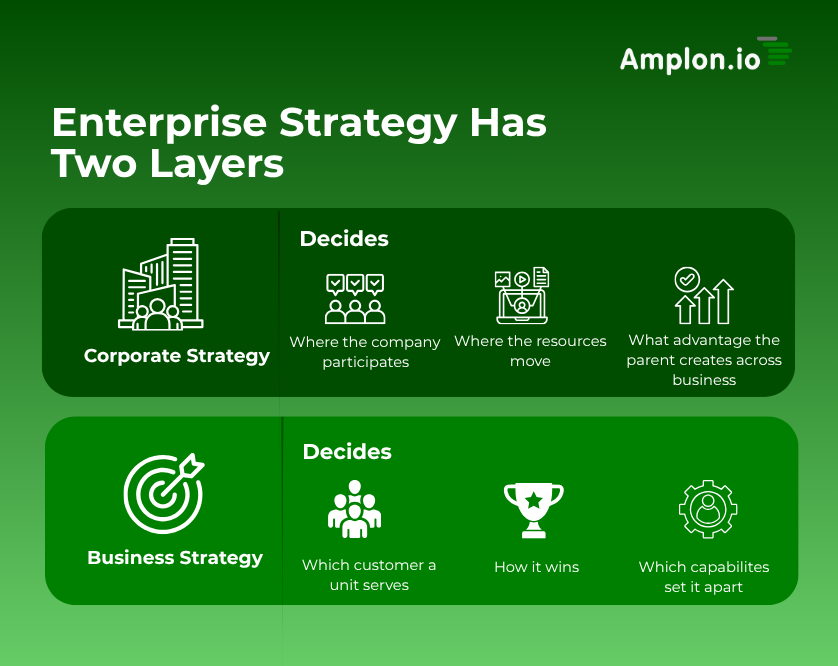
Corporate strategy decides where the company will participate, where resources will move, and what advantage the parent can create across its businesses. Business strategy decides which customers a business will serve, how it will win, and which capabilities will distinguish it from competitors. Hoshin Kanri has a narrower role. It converts the selected consequences of those choices into a plan the organization can execute and govern.
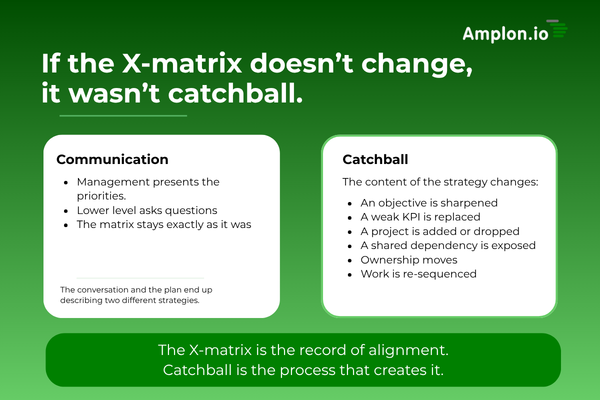
Catchball is the part of Hoshin Kanri where strategic direction is interpreted, challenged, and refined across levels and functions — vertically between management levels, horizontally between functions, and over more than one round. The why gives people the context to make sensible decisions. The how turns direction into credible contributions: measures, projects, dependencies, and commitments.
Beyond Hoshin Kanri, the collection also delves into the broader disciplines of strategic planning and strategy execution. While many organizations invest significant effort in developing robust strategic plans, a large percentage struggle to execute those plans effectively. This content addresses the common challenges that prevent successful execution and highlights the critical steps leaders must take to bridge the gap between planning and results.
Whether you are launching a new strategy, refining an existing planning process, or strengthening enterprise-wide execution capabilities, these resources provide practical insights, proven frameworks, and actionable guidance to help your organization achieve greater strategic impact and long-term success.
Strategy Execution Guides

Executing a strategy successfully is often easier said than done. Despite having a clear vision, mission, and long-term objectives, many organizations find it challenging to turn strategy into results. What’s the secret? Clear alignment, strong management, and, most importantly, a well-communicated plan that everyone in the organization can rally behind.

Even the most promising strategies can fail if structural barriers to strategy implementation within the organization stand in the way. These internal roadblocks – often embedded in culture, decision-making processes, incentive systems, or organizational design – can quietly derail execution. Identifying and addressing these barriers early on is essential to improving your chances of success.

Many managers assume execution is all about alignment. But when things go wrong, the usual culprit is a breakdown in the chain of command. As Henry Mintzberg noted in 1987, only 10% of strategies are actually executed as planned. So, maybe the issue isn’t communication—it’s the lack of proper preparation.

When organizations set out to create a strategy, one of the biggest challenges they face is the lack of a shared understanding of what a strategic framework actually looks like. It’s easy to spend weeks—sometimes months—working on a strategy, only to end up with a vague collection of goals that sound good on paper but don’t provide a clear way forward.

Strategic planning doesn’t usually fall apart because of bad ideas – it falters because people aren’t speaking the same language. Words like goal, objective, and target get thrown around as if they mean the same thing, when in fact, they each play a distinct role in shaping strategy. Getting clear on these terms isn’t just a nice-to-have—it’s essential if you want your strategy to actually move things forward.
Commitment is not about charisma or a single visionary leader. It is about leaders and employees alike choosing to align with a purpose bigger than themselves — and staying the course when challenges arise. That depth of commitment is what transforms strategy from words on paper into lasting impact.

Amplon’s licensing model (charged per X-matrix) maps differently to per-user SaaS pricing. Converting to a per-user equivalent clarifies comparisons with peers in the strategy tooling landscape.

Organizations can call their process policy deployment, strategy deployment, or Hoshin Kanri. The name does not determine its maturity.
The more useful test is whether strategy is being transmitted or managed.
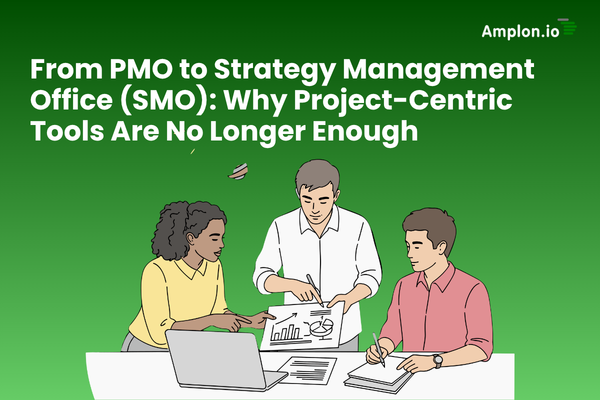
The Project Management Office solved an important problem. As organizations ran more projects, they needed common methods, reliable plans, resource coordination, risk controls, and consistent reporting. The PMO gave management a disciplined way to see whether projects were being delivered.
That mandate has expanded.
Strategy Planning Guides

In today’s complex and fast-changing business environment, strategy planning and execution cannot rely on intuition, tradition, or top-down directives alone. Organizations need a disciplined way of thinking, one that challenges assumptions, prioritizes what truly matters, and ensures alignment across all levels. This is where critical thinking plays a vital role, especially when using Hoshin Kanri as a strategic planning and execution framework.

Your organizational structure should serve your strategy – not the other way around. But too often, companies reshuffle teams or departments without rethinking culture, incentives, or decision-making processes. That’s how silos form. That’s how decisions stall. That’s how communication breaks down.

Strategic planning doesn’t usually fall apart because of bad ideas – it falters because people aren’t speaking the same language. Words like goal, objective, and target get thrown around as if they mean the same thing, when in fact, they each play a distinct role in shaping strategy. Getting clear on these terms isn’t just a nice-to-have—it’s essential if you want your strategy to actually move things forward.

A good strategy also builds a solid bridge between the organization’s vision and its key performance indicators (KPIs). That connection matters—especially at the business unit level, where strategic plans often need to adapt the broader mission to fit specific realities.

Organizations adopting Hoshin Kanri often face a choice: use a generic “all-in-one” strategy platform with some Hoshin support or a Hoshin-native tool. While generic tools like these offer polished interfaces for top-down goals, they frequently fail to support the specific, crucial mechanics of Hoshin, such as the X-Matrix, catchball, and the “leveling” of objectives. For Hoshin to work, the tool must reflect the methodology, not just the results.

Many enterprises reach for comprehensive Strategic Portfolio Management (SPM) suites to close the gap between strategy and operations. In most cases, a leaner configuration – combining a focused strategy-execution tool with existing ERP data and a BI layer – delivers the same alignment outcomes with far less cost, effort, and risk.

In most organizations, setting goals isn’t the hard part. It’s making sure that everyone is pulling in the same direction and following through. That’s where a strategy deployment matrix comes in. It connects big-picture goals with the day-to-day activities that are needed to achieve them, making it easier for teams and leaders to stay aligned and accountable.