Excel First or Software First? Rethinking How to Start Hoshin Kanri
Many organizations assume that Hoshin Kanri should begin in Excel. The team first learns the method, stabilizes the process, and only then moves to dedicated software. The sequence sounds prudent because it separates methodological learning from technology adoption. That sequence is prudent in some situations, but it is not a rule.
Excel is a useful starting tool, but it is not a compulsory apprenticeship. When top management is committed, the basic Hoshin design is understood, and ownership for data and reviews is clear, an organization can adopt software directly. In fact, starting digitally may improve the quality of learning because the organization learns inside the management system it intends to keep.
What Excel Is Good At
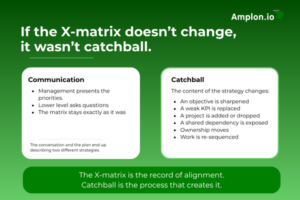
Excel lowers the threshold for starting. It is familiar, flexible, inexpensive, and easy to change. A small leadership team can test an X-matrix, revise terminology, and work through its first catchball discussions without launching a formal technology project.
That freedom matters when the organization is still asking basic questions. Which priorities are genuinely strategic? What belongs in the matrix? At what level should objectives be owned? Which KPIs indicate strategic progress rather than operational health? Early uncertainty is normal, and a spreadsheet tolerates it.
Excel can therefore be the right choice when Hoshin is being explored by one team, the number of relationships is limited, and the immediate objective is to understand the method. The problem begins when temporary flexibility becomes the architecture of the management system.
The Hidden Cost of Learning in Fragments
Hoshin Kanri does not become difficult because an X-matrix is hard to draw. It becomes difficult when several levels and functions must interpret the same priorities, negotiate their contributions, connect KPIs and initiatives, and revisit those commitments during reviews.
Consider a group objective to improve delivery reliability without sacrificing margin. One business unit focuses on production flow, another on supplier resilience, and a commercial team on demand stability. Each contribution is legitimate, but the connections matter. The teams must agree on what delivery reliability means, which measures are authoritative, where dependencies sit, and how a local improvement contributes to the group outcome.
In separate spreadsheets, the objective is copied, renamed, and interpreted locally. KPI definitions begin to diverge. A catchball decision remains in meeting notes or email, while the matrix shows only the final wording. By the time the monthly review arrives, managers spend time reconstructing which number is current and why a commitment changed.
This is not merely a document-management inconvenience. It weakens the organization’s ability to learn. The result is visible, but the reasoning, dependency, ownership, and decision history around it are fragmented.
Readiness Is Not the Same as Spreadsheet Experience
The case for starting directly in software should therefore be based on organizational readiness, not on whether the company has completed a year in Excel.
A direct implementation is credible when:
- Top management is prepared to choose a limited set of priorities, participate in catchball, and use the resulting plan in its own reviews.
- The organization has agreed the basic Hoshin architecture: planning levels, ownership, terminology, review cadence, and decision rights.
- A process owner has the authority to establish common standards and resolve design questions across functions or business units.
- KPI owners can define sources, calculations, frequency, targets, and responsibility for correcting inconsistent data.
- The first review is treated as an implementation milestone, with clear expectations for evidence, decisions, countermeasures, and follow-up.
- Leaders accept that transparency will expose unresolved dependencies, competing priorities, and weak ownership rather than merely produce a cleaner report.
None of these conditions requires a history of maintaining spreadsheet X-matrices. They require management commitment. If they are absent, software will not supply them. It will only make the absence more visible.
Starting Digitally Changes the Learning Curve
Software does not eliminate the learning curve of Hoshin Kanri. It changes what the organization learns from.
With Excel, a considerable part of the early effort goes into template design, file ownership, permissions, consolidation, and reconciliation. Teams become skilled at keeping the process running despite the medium. When they later move to software, they must redesign the process, migrate the data, reconnect relationships, and unlearn local conventions that have become embedded.
A direct digital implementation moves that effort toward the management questions themselves. Are the breakthrough objectives distinct? Does each lower-level contribution explain how it supports the higher level? Are KPI definitions consistent? Does every strategic initiative have an owner and a measurable reason to exist? What decision follows when performance is off track?
The learning is still real, but it accumulates in a shared structure rather than in a collection of files that will later be replaced.
The First Test Is the Quality of the Review
The value of direct digitalization should not be judged by how quickly the first X-matrix appears on screen. The better test is the first reliable management review.
A weak review is dominated by preparation and status explanation. Managers reconcile data, search for the latest file, and ask owners to restate the background. A stronger review begins with a common version of the plan and spends its time on interpretation: why performance moved, whether an initiative is contributing, which dependency requires escalation, and whether the response should be a countermeasure, a project change, or a change to the strategy itself.
This contrast matters to the top management team, which needs decision-ready evidence; to operational-excellence and Lean leaders, who need a disciplined problem-solving response; and to Hoshin professionals, who need alignment across levels to remain visible after planning is complete.
Better software cannot guarantee a better conversation. It can, however, remove avoidable reconstruction work and preserve the context required for that conversation.
Strategy Context Is Becoming Infrastructure
Data consistency has always mattered in Hoshin Kanri. AI makes the consequences of inconsistency much larger.
An AI assistant can summarize a review, identify a delayed initiative, or suggest a question about a red KPI. But useful advice depends on strategy context: which objective the KPI tests, how the target is defined, which initiatives are intended to influence it, who owns the decision, what was agreed through catchball, and why a previous change was made.
If that context is scattered across spreadsheets, slides, email, and meeting notes, AI must infer the relationships. It may combine different KPI definitions, treat an obsolete target as current, or recommend action without understanding a dependency negotiated at another level. The answer can sound precise while being wrong.
This is why the strategy record cannot be treated as an annual presentation file. It is becoming part of the organization’s decision infrastructure. The earlier objectives, KPIs, initiatives, owners, reviews, and changes are kept in a consistent connected model, the more reliable the accumulated strategy memory becomes. AI does not make data architecture optional; it raises the cost of getting it wrong.
The Risks of Skipping Excel
Direct adoption also has real risks. An immature organization may configure fields before it has made the underlying choices. A software project can create the appearance of progress while executives delegate Hoshin to an OpEx team. Poor KPI definitions can become standardized faster. Too much configuration can harden a process that should still be learning.
These risks are not arguments for Excel by default. They are arguments for disciplined implementation. Begin with the minimum viable Hoshin architecture. Configure only what supports the agreed planning and review process. Use real strategic content early. Test the system through catchball and a live review, not through a polished demonstration. Treat unresolved design questions as management decisions, not as requests for another field.
The sequence should follow readiness. Some organizations need a spreadsheet phase to develop it. Others already have the leadership discipline, process ownership, and strategic clarity to begin with a governed digital system.
A Practical Case of Starting Directly
Erwin Hymer Group chose the second path: it adopted Amplon directly rather than first operating Hoshin Kanri through Excel. The significance of that choice is not that every organization should do the same. It is that Hoshin maturity does not have to be built through spreadsheet administration.
In our upcoming webinar with Erwin Hymer Group’s COO, we will discuss the practical lessons behind that decision, including how to prepare the organization, manage the learning curve, build useful reviews, and digitalize Hoshin without allowing the tool to replace management responsibility.
The decision is therefore not Excel first or software first. It is whether the organization is ready to learn Hoshin in a connected management system. When the commitment and governance are present, skipping Excel can avoid a temporary structure that later has to be dismantled. When they are absent, no platform can compensate for them.
Join our upcoming webinar featuring Jan Franck, COO of Erwin Hymer Group.


We’ve been using the Amplon X-matrix tool for our 500-person organization over the past two years. It has significantly enhanced clarity. Now, we have an easily accessible clear view for everyone of our long-term goals, annual objectives, and development topics both at the organizational level and within each activity.
Moreover, the Amplon team’s responsiveness and support have been outstanding. Overall, Amplon X-matrix has been an invaluable asset for our organization.
Ari Hyvärinen,
ABB Drives Oy