How Corporate and Business Strategy Populate the Hoshin X-Matrix
Strategy documents contain choices, assumptions, analysis, targets, and initiatives. These cannot simply be copied into an X-matrix because they represent different kinds of management content.
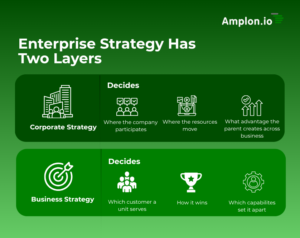
Corporate strategy decides where the company will participate, where resources will move, and what advantage the parent can create across its businesses. Business strategy decides which customers a business will serve, how it will win, and which capabilities will distinguish it from competitors.
Hoshin Kanri has a narrower role. It converts the selected consequences of those choices into a plan the organization can execute and govern. The central argument is simple: corporate strategy determines enterprise choices, business strategy determines how each business will win, and Hoshin translates the changes required now into objectives, projects, KPIs, and ownership.
The difficulty is not filling the matrix. It is preserving the strategy’s logic while changing its form.
Corporate and Business Strategy Give Hoshin Different Inputs
Corporate strategy supplies portfolio direction, enterprise priorities, shared capability choices, and resource boundaries. Some choices, such as acquiring or divesting a business, remain in corporate and board governance. Their organizational consequences may enter Hoshin when they require coordinated change.
Business strategy supplies the specific competitive logic of each unit: target customers, value proposition, basis of advantage, profit model, and required capabilities. Two businesses can support the same corporate priority through very different strategies. A third may not contribute at all.
This is the broader enterprise strategy logic that Hoshin must preserve. Business-unit matrices should not be smaller copies of the corporate matrix. Alignment is not identical wording. It is credible contribution.
Five Conversion Rules for Populating the X-Matrix
- Strategic destination -> long-term objective. State the future condition that would exist if the strategic choice succeeded. “Lifecycle services” is a direction; “lifecycle services generate a resilient share of group profit” is an outcome.
- Next proof point -> annual objective. Define what must become true this year to retain confidence in the strategy. This may be validated demand, proven economics, a removed constraint, or a working capability. It is not automatically one-fifth of a five-year target.
- Capability gap -> improvement project. Identify the deliberate change needed to move from the current state to the annual result. Projects should produce tangible deliverables and often emerge through catchball rather than arriving fully selected by the strategy team.
- Evidence of movement -> KPI. Measure whether the intended outcome is emerging, not merely whether work was performed. A completed platform is a milestone; improved connectivity, service margin, or customer uptime indicates strategic contribution.
- Contribution and authority -> correlations and ownership. Show which projects are expected to move which objectives, which KPIs provide evidence, and who can intervene. The correlations are management hypotheses, not decoration.
These rules keep choices, outcomes, work, and evidence from being mixed together. They also keep the matrix focused on deployment rather than turning it into a compressed strategy document.
Example: From Corporate Strategy to a Business X-Matrix
Consider Arden Industrial Group, a fictional manufacturer with food-processing equipment, mining equipment, and industrial-components businesses. The figures are illustrative.
Corporate management makes three choices:
- Shift the group’s earnings mix from cyclical equipment sales toward recurring lifecycle services.
- Concentrate the first wave of investment in food processing and mining, where installed bases and customer downtime create strong service economics.
- Build parent advantage through a shared equipment-data platform and common service-commercial capabilities. Do not force the components business into the same agenda.
The food-processing business makes its own choices:
- Target processors for whom unplanned line downtime is economically critical.
- Compete on guaranteed equipment availability and rapid recovery rather than lowest purchase price.
- Monetize connected monitoring and preventive service through outcome-based contracts.
Corporate X-matrix
- Long-term objective: By 2030, lifecycle services deliver 35 percent of group gross profit through scalable connected-service models in the two priority businesses.
- Annual objectives: Validate profitable outcome-based offers in food processing and mining; connect 45 percent of the eligible installed base in the first two product families.
- Improvement projects: shared equipment-data platform; service economics and contract model; commercial capability program.
- KPIs: recurring service gross-profit share; eligible installed base connected; service contribution margin.
- Ownership: Group EVP for Services owns the outcome, the CIO owns the platform, and the two business presidents own their contributions.
Food-processing business X-matrix
- Long-term objective: By 2030, become the preferred uptime partner in two selected food-processing segments, with outcome-based services generating 25 percent of business-unit gross profit.
- Annual objectives: Secure 20 uptime contracts at the target contribution margin; demonstrate a 30 percent reduction in unplanned downtime across pilot customers.
- Improvement projects: remote-monitoring offer; outcome-contract and pricing design; field-service response redesign.
- KPIs: contracted recurring value; pilot contribution margin; customer uptime.
- Ownership: The business president owns the objectives, while service, sales, digital, and operations leaders own the projects.
The business matrix contributes without repeating the corporate plan. Its uptime position supports the group’s lifecycle-services outcome. Its contracts and connected equipment support the corporate annual objectives. The shared data platform remains one corporate project rather than being copied into every matrix.
Mining can contribute through remote-site productivity and autonomous equipment support. Industrial components is deliberately excluded. That exclusion matters: a strategy is not aligned merely because every unit receives the same objective.
In a digital Hoshin environment such as Amplon, parent-child objective links and shared projects or KPIs can represent these relationships without duplication.
The Five-Phase Planning Process
- Make the strategy choices. Corporate management defines portfolio direction, parent advantage, shared capabilities, and resource priorities. Each business defines its customers, value proposition, basis of advantage, and required capabilities.
- Draft the corporate X-matrix. Convert the selected enterprise choices into long-term outcomes, next-year proof points, likely shared projects, KPIs, and executive ownership. Treat this as a proposal.
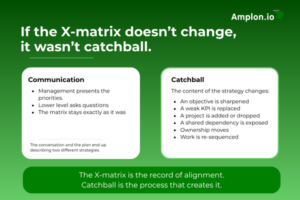
- Run catchball with the businesses. Business leaders interpret the direction through their own strategies and propose contributions, projects, targets, resources, and dependencies. A credible response may also explain why a business should not participate.
- Build and reconcile the lower-level matrices. Agree business and functional contributions, identify shared work, remove duplicate initiatives, and resolve sequencing and resource conflicts. Vertical alignment shows contribution; horizontal alignment determines whether the combined plan can work.
- Confirm resources and govern execution. Reconcile budgets, talent, and capacity before approval. Review projects and KPIs monthly, objectives quarterly, and the underlying strategic choices when execution evidence challenges an important assumption.
This process is not a straight cascade. Corporate management proposes direction, businesses translate it, functions expose what must change, and catchball reshapes the commitment.
What Stays Outside the X-Matrix
- Analysis and strategic reasoning: market evidence, competitor assessment, scenarios, assumptions, trade-offs, and rejected alternatives.
- Corporate and board decisions: acquisitions, divestments, capital governance, and formal risk decisions, even when their consequences create Hoshin work.
- Routine management: standard operational responsibilities, established controls, and business-as-usual performance management.
These processes remain connected to Hoshin through evidence, constraints, funding, and escalation. They simply are not X-matrix content.
One Test Before Approval
Before approving the matrices, management should be able to answer one question: Can we trace every X-matrix item to a strategic choice, explain its contribution, and identify what we deliberately left out?
If the answer is yes, the matrix is likely focused enough to govern. If not, it is probably mixing strategy, operations, and activity into one crowded plan.
A strong X-matrix is neither a strategy summary nor an action list. It is the management architecture for the part of enterprise strategy the organization has decided to make real now.
FAQs
Hoshin Kanri software is a digital system for managing strategy deployment. It typically connects long-term objectives, annual priorities, initiatives, KPIs, ownership, alignment across organizational levels, and recurring management reviews.
Core capabilities usually include an interactive X-matrix, objective alignment, initiative and project management, KPI tracking, ownership, review dashboards, access controls, and change history. Buyers should also test how these capabilities work together during a realistic management review.
No. The X-matrix represents relationships among objectives, initiatives, measures, and owners. Hoshin Kanri also requires catchball, execution management, review, intervention, and learning. Software should support the wider management cycle.
Use the same realistic strategy scenario for every shortlisted vendor. Include a KPI deviation, a cross-functional dependency, and a decision that changes the plan. Compare how quickly managers can understand the context, make and record the decision, update affected commitments, and recover the reasoning later.
The case becomes stronger when multiple matrices, functions, owners, initiatives, and review cycles create significant reconciliation work or make relationships difficult to maintain. The decision should be based on management-system complexity, not on spreadsheet age alone.

We’ve been using the Amplon X-matrix tool for our 500-person organization over the past two years. It has significantly enhanced clarity. Now, we have an easily accessible clear view for everyone of our long-term goals, annual objectives, and development topics both at the organizational level and within each activity.
Moreover, the Amplon team’s responsiveness and support have been outstanding. Overall, Amplon X-matrix has been an invaluable asset for our organization.
Ari Hyvärinen,
ABB Drives Oy