How to Choose Hoshin Kanri Software: Run the Review Before You Buy
Most Hoshin Kanri planning software evaluations begin with a feature checklist.
Does the platform have an X-matrix? Can it cascade objectives? Does it track KPIs and projects? Can it produce dashboards, send reminders, manage access rights, and integrate with other systems?
These questions are necessary. They are also easy for a polished demonstration to answer. The harder question is whether the software can support the management process after the plan has met reality.
That is where Hoshin Kanri succeeds or fails. Objectives are already defined. Initiatives are underway. Measures have started to move. One function is waiting for another. A strategic assumption looks weaker than it did during planning. Management must understand what changed, decide what to do, and keep the rest of the strategy coherent.
A feature list does not show how well a platform handles that moment. A simulated management review does. The strongest way to choose Hoshin Kanri software is therefore to run the review before buying the system.
Why the Standard Software Demo Is Too Easy
Vendor demonstrations usually begin from a clean state. The strategy is well structured. Objectives have owners. Projects are linked correctly. KPIs contain current data. Dashboards are visually complete.
This is useful for learning the interface. It is a weak test of the management system. Real strategy execution is less orderly. Updates arrive at different times. A KPI may deteriorate while the related project remains green. One initiative may support several objectives. A dependency may sit outside the authority of the person reporting the problem. A change in timing may protect one priority while weakening another.
These conditions create the actual work of Hoshin management. Leaders must interpret relationships, not merely inspect statuses. This is also why feature-by-feature vendor comparisons age quickly. Interfaces change. Pricing changes. Capabilities expand. A table that appears precise at publication can become misleading within months.
The underlying management requirements are more stable. Hoshin Kanri still needs to connect direction, contribution, execution, measures, ownership, and review. The software should be judged by how well it helps managers operate those relationships when execution becomes uncertain.
Start With a Management Scenario, Not a Product Tour
Before inviting vendors, define one realistic scenario from your own strategy deployment process.
Keep it small enough to build quickly, but complex enough to expose management behavior. A useful test case contains:
- one enterprise objective;
- two or three contributing functions;
- at least one shared initiative;
- one outcome measure and one leading measure;
- a dependency that crosses authority boundaries; and
- a decision that could change scope, timing, resources, or ownership.
For example, suppose an organization wants to improve on-time delivery from 86% to 95%. Procurement is qualifying alternative suppliers. Production is improving schedule adherence. Engineering must approve material changes. Demand planning is trying to reduce late priority changes.
The initiatives look reasonable when viewed separately. Their contribution depends on timing and coordination across functions. Now introduce a realistic disruption. The delivery KPI has declined for a second month. Supplier qualification is on schedule, but engineering capacity has become the bottleneck. At the same time, the demand mix has shifted toward products that rely on the constrained approval process.
This is no longer a reporting problem. It is a management decision. The evaluation should ask every shortlisted platform to support the same review scenario. Do not let each vendor choose the cleanest story for its own architecture.
Test 1: Can Managers Recover the Strategic Context?
The first test is not whether the system can show a red KPI. Almost any reporting tool can do that. The test is whether a manager can move from the signal to the relevant strategic context without having to reconstruct it manually.
From the delivery deviation, can the review team see:
- which objective is at risk;
- which initiatives are expected to influence the result;
- which functions and owners are involved;
- which dependency has become binding;
- which assumptions supported the original plan; and
- what changed since the previous review?
This is relationship integrity. The information may exist somewhere on a general-purpose platform, but its existence is not the same as its usability during a management discussion.
If the review team must open several dashboards, compare separate project plans, search meeting notes, and ask someone to explain the original logic, the system is storing information without preserving management context.
Good Hoshin Kanri software should shorten the distance between a signal and the strategic relationships needed to interpret it.
Test 2: Does the System Distinguish Status From Contribution?
Project status and strategic contribution are not the same. In the example, supplier qualification may be green because its milestones are on time. Yet the initiative may not improve delivery reliability as expected, because engineering approval has become the limiting factor.
A conventional project view can accurately report on both projects while leaving management with the wrong impression. During the simulated review, ask how the platform helps managers examine contribution:
- Can they see the relationship between an initiative and the measures it is expected to influence?
- Can they distinguish work completed from strategic effect achieved?
- Can they identify an initiative that remains active but has lost its contribution logic?
- Can they record that an assumption has weakened without falsely marking all execution as failed?
This matters because Hoshin Kanri is not a collection of projects. It is a theory of how coordinated work will produce strategic change. Software should help managers test that theory, not only monitor whether tasks are being completed.
Test 3: Can the Review Produce a Decision?
Many platforms are strong both before and after the review. They collect updates beforehand and distribute actions afterward. The decision itself still happens outside the system.
That creates a gap in the management record. For the delivery scenario, management might decide to reassign engineering capacity, resequence supplier approvals, pause a lower-priority initiative, or revise the expected timing of the delivery improvement.
The software evaluation should test whether the review can make that decision explicit.
- Can the team identify the decision owner?
- Can it record the decision and its rationale?
- Can it connect the decision to the affected objective, initiatives, measures, and dependencies?
- Can it assign the resulting actions without reducing the decision to a task list?
- Can the next review distinguish what was decided from what was merely discussed?
Reporting makes a condition visible. Governance changes what happens next. Hoshin Kanri software should support that transition.
Test 4: Can the Plan Change Without Losing Its History?
Strategy software often promises a single source of truth. That phrase can hide an important question: truth as of when?
Hoshin plans change. An initiative is paused. Timing moves. Ownership changes. A KPI definition is refined. A resource commitment is transferred. An assumption is rejected. If the platform only shows the current configuration, managers lose the reasoning that explains how the strategy evolved. If every change requires a new file or copied plan, the organization loses continuity in another way.
The review simulation should therefore include a material change. Ask the vendor to alter the plan and then show:
- the previous commitment
- the new commitment;
- who made the change;
- why it was made;
- which related elements were affected; and
- what the next review should examine.
Traceability is not administrative decoration. It protects organizational memory. It helps managers separate unexplained drift from deliberate adaptation.
Test 5: Can the Right People Participate Without Creating a Reporting Industry?
Hoshin Kanri depends on participation across organizational levels and functions. The Lean Enterprise Institute describes strategy deployment as a top-down and bottom-up dialogue in which teams test the time and resources needed to achieve targets. That dialogue cannot be sustained by a small central team maintaining the system on everyone else’s behalf.
The software evaluation should examine the participation model as carefully as the interface.
- Who can view the relevant strategic context?
- Who can update measures and initiatives?
- How are different roles guided toward the information they need?
- How much training is required before an owner can provide a useful update?
- Does the licensing model discourage broader participation?
- How much work remains for the PMO or strategy office to reconcile data, prepare slides, and chase updates?
A platform can be technically collaborative while remaining operationally centralized. If adoption creates a new reporting bureaucracy, the software has reduced file fragmentation without reducing management friction.
Test 6: Can the Review Run Without a Parallel Reporting System?
Implementation milestones are usually technical: configuration complete, users created, data imported, integrations connected, training delivered.
None of these proves that the organization can run its strategy reviews from the platform. Require the pilot team to conduct one end-to-end review with the software as the primary management surface. Source data may still come from operational systems, but the strategic context, discussion, decision, and resulting change should not depend on a presentation assembled for the meeting.
Observe what managers still rebuild elsewhere. A separate calculation may reveal an integration need. A separate slide that reconnects the objective, KPI, initiatives, owners, and decision reveals a deeper architecture gap. A private notes document may show that the platform records status but not management reasoning.
The purpose is not to prohibit PowerPoint or Excel. It is to discover whether parallel tools are supplementing the review or reconstructing the management system.
Ask vendors to show the shortest credible route to a review that can be prepared, conducted, and followed up without rebuilding strategic context. Then test what the organization must contribute: data preparation, process design, governance decisions, integrations, training, and change management.
Fast technical setup can still leave the review dependent on manual reporting. Extensive configuration can also delay learning from actual use. The goal is the lightest implementation that allows managers to complete one full review cycle and improve it over time.
What a Serious Hoshin Kanri Software Evaluation Should Produce
The outcome of the selection process should be more than a weighted feature score. It should leave the organization with a clearer definition of its own management system.
The evaluation should establish:
- which strategic relationships must remain connected;
- which roles participate in planning, updating, reviewing, and deciding;
- which deviations require local countermeasures and which require strategic intervention;
- how changes will be authorized and traced;
- what information must come from other systems; and
- what an end-to-end review must accomplish in practice.
This definition improves the buying decision even when several products appear capable. It also prevents the organization from asking software to compensate for unresolved governance.
Amplon is designed around connected X-matrix logic, alignment across organizational levels, integrated initiatives and KPIs, review views, and change history. Those capabilities matter because they support a particular management process. They should still be tested against the buyer’s real scenario, with the people who will operate the reviews.
No vendor should be selected only because its demonstration looks complete. The platform should demonstrate that it can support the difficult part of Hoshin Kanri: interpreting evidence and coordinating action without losing strategic direction.
Choose the Review, Not the Feature List
The best Hoshin Kanri software is not the product with the longest checklist or the most polished dashboard. It is the system that helps the organization conduct better management conversations when the plan no longer reflects reality.
That is why the review should come before the purchase decision. Build one credible strategic scenario. Introduce a cross-functional deviation. Ask managers to recover the context, test contribution, make a decision, change the plan, and preserve the reasoning.
The exercise will reveal more than a comparison table. It will show whether the software can help the organization manage Hoshin Kanri as a living system rather than store it as a finished plan.
FAQs
Hoshin Kanri software is a digital system for managing strategy deployment. It typically connects long-term objectives, annual priorities, initiatives, KPIs, ownership, alignment across organizational levels, and recurring management reviews.
Core capabilities usually include an interactive X-matrix, objective alignment, initiative and project management, KPI tracking, ownership, review dashboards, access controls, and change history. Buyers should also test how these capabilities work together during a realistic management review.
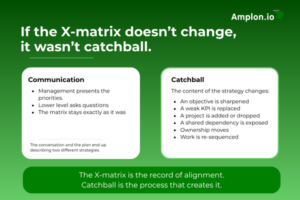
No. The X-matrix represents relationships among objectives, initiatives, measures, and owners. Hoshin Kanri also requires catchball, execution management, review, intervention, and learning. Software should support the wider management cycle.
Use the same realistic strategy scenario for every shortlisted vendor. Include a KPI deviation, a cross-functional dependency, and a decision that changes the plan. Compare how quickly managers can understand the context, make and record the decision, update affected commitments, and recover the reasoning later.
The case becomes stronger when multiple matrices, functions, owners, initiatives, and review cycles create significant reconciliation work or make relationships difficult to maintain. The decision should be based on management-system complexity, not on spreadsheet age alone.

We’ve been using the Amplon X-matrix tool for our 500-person organization over the past two years. It has significantly enhanced clarity. Now, we have an easily accessible clear view for everyone of our long-term goals, annual objectives, and development topics both at the organizational level and within each activity.
Moreover, the Amplon team’s responsiveness and support have been outstanding. Overall, Amplon X-matrix has been an invaluable asset for our organization.
Ari Hyvärinen,
ABB Drives Oy