Catchball in Hoshin Kanri: Turning the X-Matrix Into a Shared Plan
An X-matrix shows what an organization intends to achieve: long-term objectives, annual priorities, projects, KPIs, and owners. It makes the structure of strategy visible.
What it cannot show is whether people understand why those choices matter, or how the organization will make them work. That is the job of catchball.
What catchball actually is
Catchball is the part of Hoshin Kanri where strategic direction is interpreted, challenged, and refined across levels and functions — vertically between management levels, horizontally between functions, and over more than one round. The why gives people the context to make sensible decisions. The how turns direction into credible contributions: measures, projects, dependencies, and commitments.
People are rarely motivated by another target. They are motivated when they understand the problem the strategy is trying to solve, why this direction was chosen, and how their work moves it. Management gains something too: the people closest to execution explain what the strategy will actually require.
That is where alignment happens — not when everyone accepts the original plan, but when the organization reaches a shared interpretation it can execute.
Catchball must change the matrices
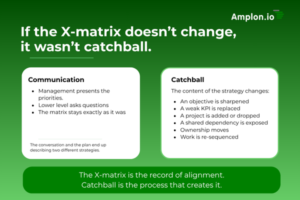
Catchball is often run as a discussion around a finished X-matrix. Senior management presents the priorities, lower levels ask questions, and the matrix stays exactly as it was. That is communication, not catchball.
A real catchball process changes the content of the strategy. It sharpens an objective, revises a target, replaces a weak KPI, adds or drops a project, exposes a shared dependency, moves ownership, or re-sequences work. Those decisions then have to be recorded in the relevant X-matrices. Otherwise the conversation and the formal plan describe two different strategies.
One objective, different contributions
Consider an industrial manufacturer that wants to cut order-to-delivery lead time from 16 weeks to 10.
The first corporate X-matrix draft contains:
- Annual objective: reduce order-to-delivery lead time to 10 weeks
- Project: automate production planning
- KPI: average order-to-delivery lead time
- Owner: Chief Operating Officer
The what is clear. The why and how are not.
During catchball, senior management explains the strategic reason. The company does not want operations to work faster in general. It wants to compete through configurable products that can be quoted and delivered faster than fully engineered-to-order alternatives. That changes how every level reads the objective.
The business unit then challenges the target. A single group average mixes configurable products with genuinely customized orders, so it can improve while priority customers still wait too long. Management agrees to apply the 10-week target to two configurable product families and to track median lead time and the share of orders delivered within 10 weeks. The corporate X-matrix is updated: the objective gains a scope boundary, and the KPI is replaced.
Sales explains that late customer changes keep restarting engineering work. Its X-matrix adds an objective for orders with an approved configuration freeze before engineering begins, a KPI for configuration-freeze compliance, and a project to redesign quotation and order confirmation.
Engineering explains that lead time depends on reducing product variation, not on processing the same variety faster. Its X-matrix adds an objective for reuse of approved modules, a KPI for engineering hours per configurable order, and a project to build a common module and interface library.
The plant explains that planning automation adds little until engineering releases are stable. Its X-matrix adds a KPI for release-to-production queue time and a project to improve changeovers at the real bottleneck. The automation project moves later in the sequence.
Horizontal catchball exposes one more dependency: sales and engineering need the same product-configuration rules. The corporate matrix adds a shared configuration project with one executive owner, and the business-unit, sales, engineering, and plant matrices link their objectives to that work and to the corporate lead-time objective.
The result is not four copies of the same target. It is one strategic intention translated into different but connected contributions.
What the process achieves
The why is now shared: not speed for its own sake, but a deliberate shift toward a configurable offer and a stronger customer promise.
The how is explicit. Sales stabilizes the customer specification. Engineering reduces unnecessary variation. The plant fixes the bottleneck. A shared configuration capability connects them, and the sequence follows the dependencies.
The X-matrices record the outcome:
- The corporate matrix holds the refined objective, its scope boundary, meaningful KPIs, the shared project, and ownership.
- Each lower-level matrix holds the contribution that its management team can own and influence.
- The links between matrices show how those contributions support the same enterprise result.
- Shared projects and dependencies appear once, with clear ownership, instead of being duplicated in every plan.
The matrix is the visible record of alignment. Catchball is the management process that creates it.
The test of catchball
After catchball, management should be able to ask two questions at every level:
- Do people understand why this objective matters and how their contribution supports it?
- Do the connected X-matrices accurately record what was agreed?
A no to the first means there is no shared interpretation. A no to the second means there is no reliable management system.
The X-matrix gives strategy a visible what. Catchball gives it a shared why and a workable how. Strategy execution needs all three.

We’ve been using the Amplon X-matrix tool for our 500-person organization over the past two years. It has significantly enhanced clarity. Now, we have an easily accessible clear view for everyone of our long-term goals, annual objectives, and development topics both at the organizational level and within each activity.
Moreover, the Amplon team’s responsiveness and support have been outstanding. Overall, Amplon X-matrix has been an invaluable asset for our organization.
Ari Hyvärinen,
ABB Drives Oy